


Jak zdemontować dysze z wanny jacuzzi?
2026-05-22 15:30Demontaż dysz nie jest skomplikowanym zadaniem, pod warunkiem — a jest to warunek konieczny — że uszanujemy logikę konstrukcyjną wanny jacuzzi.
Właściwa perspektywa "Demontaż dysz jacuzzi spa"
Demontaż dysz w jacuzzi nie jest czynnością niszczącą, lecz standardową czynnością w ramach rutynowego procesu konserwacji.

Z punktu widzenia zawodowego najlepiej scharakteryzować ją jako:
• Uwalnianie połączeń strukturalnych;
• Tymczasowe odłączenie punktów poboru wody;
• Stworzenie warunków niezbędnych do czyszczenia i konserwacji.
Zrozumienie tego rozróżnienia pomaga złagodzić wszelkie obawy psychologiczne, jakie można mieć w związku z usunięciem dysz.
The jets serve as the terminal outlets of the spa Jacuzzi's water circulation system, while also being the components that users can directly see and touch. Consequently, jet designs must not only satisfy hydraulic requirements but also balance considerations of safety and aesthetics.
Are Spa Jacuzzi Jets Fixed or Removable?
While not all spa Jacuzzi jets share an identical structure, the vast majority of modern spa tubs feature jets designed with a removable structure.
This design choice is driven by the following factors:
•Jets require periodic cleaning.
•Limescale and residue tend to accumulate around the jets.
•The internal plumbing system requires maintenance.
Typically, spa Jacuzzi jets are not permanently bonded in place; instead, they are secured to the tub's inner shell using mechanisms such as rotation, snap-fit clips, or combined structural assemblies.

What Preparations Are Needed Before Removing Spa Jacuzzi Jets?
Before you officially begin removing the jets from your spa Jacuzzi tub, one point must be clearly understood:
Removing a jet is not as simple as merely giving it a casual twist; rather, it is a process that requires logical assessment and judgment.
Before proceeding with any operations, at least the following preparatory steps must be completed:
•Ensure that the spa jacuzzi tub is powered off.
•Ensure that the nozzles are not under water pressure.
•Carefully observe and identify the structural design of the nozzles.
Understanding how the nozzles are secured is crucial for avoiding damage to both the spa jacuzzi tub liner and the nozzle body itself.
What are the common methods used to secure spa jacuzzi tub nozzles?
From a structural engineering perspective, the methods used to secure spa jacuzzi tub nozzles primarily fall into the following categories:
1. Rotary Locking Mechanism
This is the most common type of structure. The nozzle forms a mechanical lock with its housing (socket) by being rotated either clockwise or counter-clockwise.
2. Snap-Fit (Clip-in) Mechanism
The nozzle is secured via internal elastic clips; it requires a specific angle or application of force to be released.
3. Modular (Combination) Structure
The outer casing of the nozzle is separate from its internal components; the outer shell is removable, while the internal components remain fixed.
Identifying which structural type a specific nozzle belongs to is the prerequisite for determining the correct disassembly method.
How can you determine if a spa jacuzzi tub nozzle can be removed simply by rotating it?
To determine whether a nozzle can be removed via rotation, consider the following indicators:
•Does the edge of the nozzle feature any non-slip textures or knurling?
•Is there any visible rotational clearance or gap around the nozzle?
•Does the nozzle feel loose or give slightly when subjected to a gentle rotation?
In the vast majority of spa jacuzzi tubs, nozzles can be removed without the need for brute force or heavy tools. If you encounter significant resistance while attempting to rotate a nozzle, stop immediately to avoid damaging the internal components.
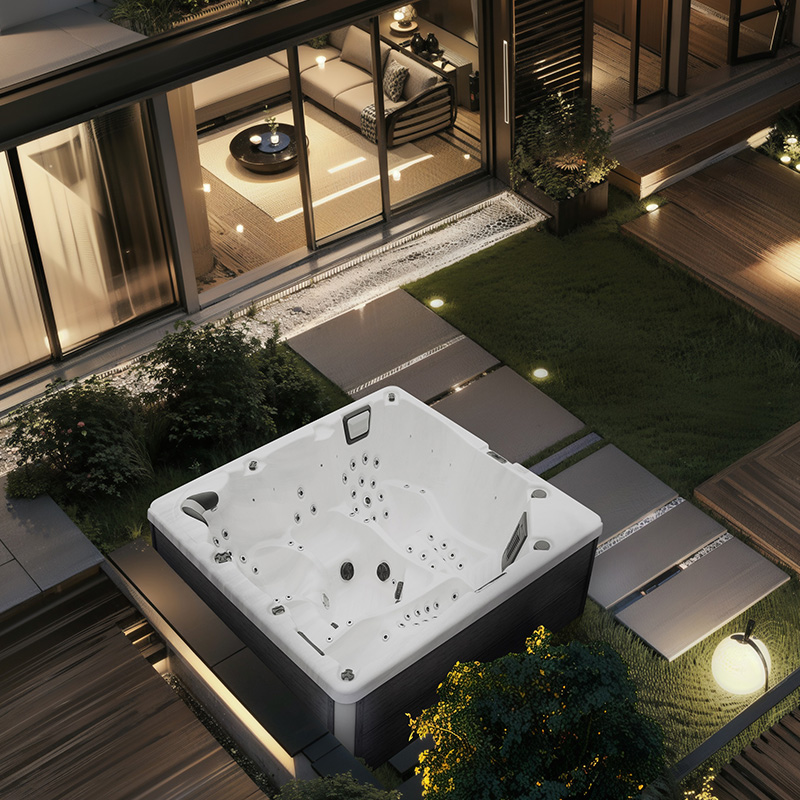
What is the fundamental logic behind correctly disassembling a spa jacuzzi tub nozzle?
Although the structural details may vary slightly between different spa jacuzzi tubs, the logical steps involved in disassembling the nozzles remain highly consistent.
From a professional standpoint, the disassembly logic can be summarized as follows:
1.Identify the specific type of nozzle.
2.Locate the specific points where force should be applied to the nozzle.
3.Apply an action that is the reverse of the original securing method (e.g., counter-rotation if it was secured by rotation).
4.Apply force in a uniform and steady manner.
This logical approach applies to the vast majority of spa jacuzzi tub nozzles.
Why is it not recommended to use tools to forcibly remove spa jacuzzi tub nozzles?
When attempting to remove spa jacuzzi tub nozzles, many people instinctively reach for tools such as pliers or screwdrivers. However, from a professional maintenance perspective, this practice carries significant risks. The reasons are as follows:
•Nozzles are typically made of plastic or composite materials.
•Tools can easily cause surface scratches.
•Applying improper force may damage the nozzle housing (seat).
•The surface of the tub liner may be damaged.
The removal of a spa or Jacuzzi tub nozzle is, fundamentally, a process of structural release rather than mechanical destruction.
What are the most easily overlooked details during the nozzle removal process?
When removing spa or Jacuzzi tub nozzles, several details are often overlooked:
•There may be a sealing ring located inside the nozzle.
•An incorrect removal angle can cause the nozzle to jam.
•Once detached, the entire nozzle assembly must be removed as a single unit.
If these details are mishandled, they may compromise the subsequent re-installation process.
What precautions should be taken regarding a spa jacuzzi tub nozzle once it has been removed?
Removing a nozzle from a spa jacuzzi tub does not signify the end of the process.
From the perspective of structural integrity, the following points require attention:
•Do not arbitrarily disassemble the internal components of the nozzle.
•Ensure that the sealing components remain intact.
•Avoid exposing the nozzle to high temperatures or intense light.
The nozzle is a critical component of the spa jacuzzi tub's water circulation system; its structural integrity directly impacts the unit's overall performance.
Why does the difficulty of removing nozzles vary across different spa jacuzzi tubs?
Differences in the nozzle removal experience across various spa and Jacuzzi tubs stem primarily from:
•Variations in structural design.
•The age and service life of the unit.
•The specific tightness of the fit between the nozzle and the tub liner.
While these factors may influence the smoothness of the removal process, they do not alter the fundamental principles of nozzle removal.
Does removing a nozzle compromise the watertight integrity of the spa jacuzzi tub?
This is a concern shared by many users.
From a design perspective, spa Jacuzzi tub nozzles are inherently designed as serviceable components; their watertight integrity relies upon:
•The structure of the nozzle housing (seat).
•The condition of the sealing ring.
•Whether the nozzle is installed correctly and seated properly.
Provided that both the removal and re-installation processes adhere to the original structural design logic, the watertight integrity of the spa or Jacuzzi tub will not be compromised.

Are all spa and Jacuzzi tub nozzles suitable for user-performed removal?
From a structural design standpoint, the vast majority of spa jacuzzi tub nozzles are designed to be removable. However, whether it is suitable for a user to perform this task independently depends on the following factors:
•Their level of understanding regarding the structure;
•Whether the procedure is executed in a standardized manner;
•Whether the application of excessive force can be avoided.
Removing the jets is not a complex task, provided—and this is the crucial prerequisite—that one respects the structural logic of the spa jacuzzi tub.
A Proper Perspective on "Removing Spa Jacuzzi Jets"
Removing the jets from a spa jacuzzi is not a destructive act; rather, it constitutes a standard step within the routine maintenance process.
From a professional standpoint, it is best characterized as:
•Releasing structural connections;
•Temporarily disengaging the water outlet points;
•Facilitating the conditions necessary for cleaning and maintenance.
Understanding this distinction helps to alleviate any psychological apprehensions one might harbor regarding the removal of the jets.